How to Set Up Leave Management That Grows With Your Business
Informal leave tracking works — until it doesn't. Here's how to build a leave process that scales from your fifth hire to your fiftieth, without becoming a corporate burden.
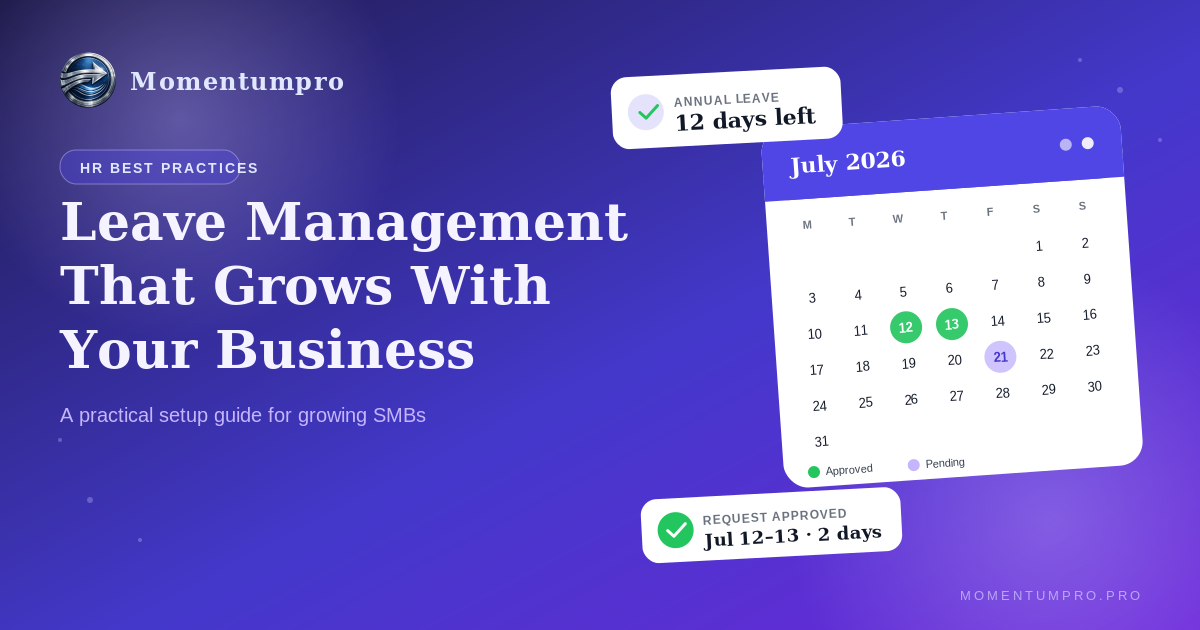
For the first few hires, leave management barely feels like a system. Someone messages the owner, the owner says yes, and everyone gets on with it. Nobody's counting days too carefully, calendars get updated when they get updated, and if two people happen to be off at the same time, you find out on the morning of. It works, more or less, because everyone can see everyone.
Then you hire the tenth person. Then the fifteenth. And somewhere between those two numbers, a small, quiet crisis begins. Someone takes a day they don't technically have. Two team members book the same week off and nobody catches it until the customer emails. A departing employee is owed a payout for accrued leave that nobody can reconstruct because the record lives in three WhatsApp threads and a paper notebook. Payroll is now doing detective work every month.
Leave management is one of those areas where the failure is gradual and almost invisible until it's expensive. The good news is that fixing it doesn't require a heavy, corporate-feeling process. It requires a bit of structure in the right places, and the discipline to keep the informal parts informal without letting them do the work of a system.
Get the policy on paper before anything else
Almost every messy leave situation traces back to the same root cause: nobody wrote down the rules. How many annual leave days does each employee get? Do they accrue monthly or are they granted up front on the anniversary? Can unused days roll over into next year, and if so, how many? What's the notice period for booking time off? How is sick leave different from personal leave? Who has to approve what?
If you can't answer those questions in one paragraph, your employees can't either — and every disagreement about leave will become a negotiation from scratch. Writing the policy down is the single highest-leverage thing you can do, and it doesn't need to be long. A one-page document that covers entitlement, accrual, approval, and carryover is enough for most small businesses to run cleanly for years. What matters is that everyone is working from the same page, literally.
Give employees a real way to request time off
The biggest source of friction in informal leave systems isn't the taking of leave — it's the asking. When an employee has to time a hallway conversation, remember to send a follow-up message, and hope the manager remembers to approve it before payroll runs, everyone loses. The employee doesn't know if it's confirmed. The manager forgets it exists. HR gets the news two weeks late.
The fix is small but transformative: employees submit leave requests through a system, see their remaining balance before they submit, and get a clear response. That's it. What this really does is convert an anxious social interaction into a routine transaction. The employee stops feeling like they're asking for a favour. The manager stops feeling like they're being ambushed. And the record is created automatically, at the moment of the request, in a place everyone can find.
Give managers a real approval flow
The other half of the transaction is the manager side, and it deserves the same care. When leave approvals live in email or messaging apps, three things go wrong. Requests get lost in noisy inboxes. Managers approve without seeing who else is off during that period. And there's no simple way for someone to cover when the primary approver is themselves on holiday.
A proper approval flow solves all three quietly. The request lands in one place. The manager sees, at a glance, who else on the team is already booked off during that window. And if the approver is unavailable, the request routes to a delegate rather than sitting in an inbox nobody's watching. Managers stop being a bottleneck, and employees stop chasing.
Automate the accruals so payroll can trust the numbers
The most common source of end-of-year drama is accrual arithmetic. Half a day used in March, three days in July, one carried over from last year, sick leave counted separately, a public holiday that fell on a scheduled day off — by December, nobody can reconstruct the truth from memory. If the employee leaves, the payout calculation becomes a small excavation project.
The system that saves you here isn't complicated. Every time leave is granted, taken, or accrued, the balance updates automatically. Every employee can see their own current balance. Every request checks against that balance before it can be submitted. And payroll pulls the numbers directly instead of asking someone to send an updated spreadsheet by Thursday. When accruals are automated, month-end stops being a scramble and year-end stops being a negotiation.
Use the data you're now collecting
Once leave is tracked properly, you get something you didn't have before: a picture of what's actually happening. Which teams are running hot? Who hasn't taken a day off in six months and is probably about to burn out? When are the natural quiet weeks where big projects should be scheduled? Which public holidays cluster with school breaks and create predictable coverage gaps you should plan for?
Small businesses often overlook this because they associate reporting with big-company overhead. But the same data that keeps payroll accurate is also, quietly, a workforce planning tool. Ten minutes a month looking at the leave calendar tells you more about your team's health and rhythm than most owners realise. And catching a burnout risk early is dramatically cheaper than replacing the person who quits because they never got a break.
Leave is a trust signal
Underneath the mechanics of days and balances, there's something more important going on. How you handle leave sends a message to your team. If requests get answered quickly and fairly, people feel respected. If balances are transparent and accurate, people trust the system. If time off is easy to take, people actually take it — and come back better for it. Companies with clean, low-friction leave processes tend to have healthier teams, not because the process itself is magical, but because it removes a hundred small daily frictions that quietly wear people down.
You don't need to over-engineer this. You need a written policy, a place employees can request time off without asking twice, an approval flow that shows managers the full picture, automatic balances that payroll can rely on, and enough reporting to spot problems before they become expensive. Get those five right and leave management stops being a source of confusion and becomes, quietly, one of the parts of your business that just works.