7 Signs Your HR Operations Have Outgrown Spreadsheets
There's a moment in every growing company when the spreadsheet stops being a tool and starts being a liability. Here are seven signs you've hit it — and what it's quietly costing you.
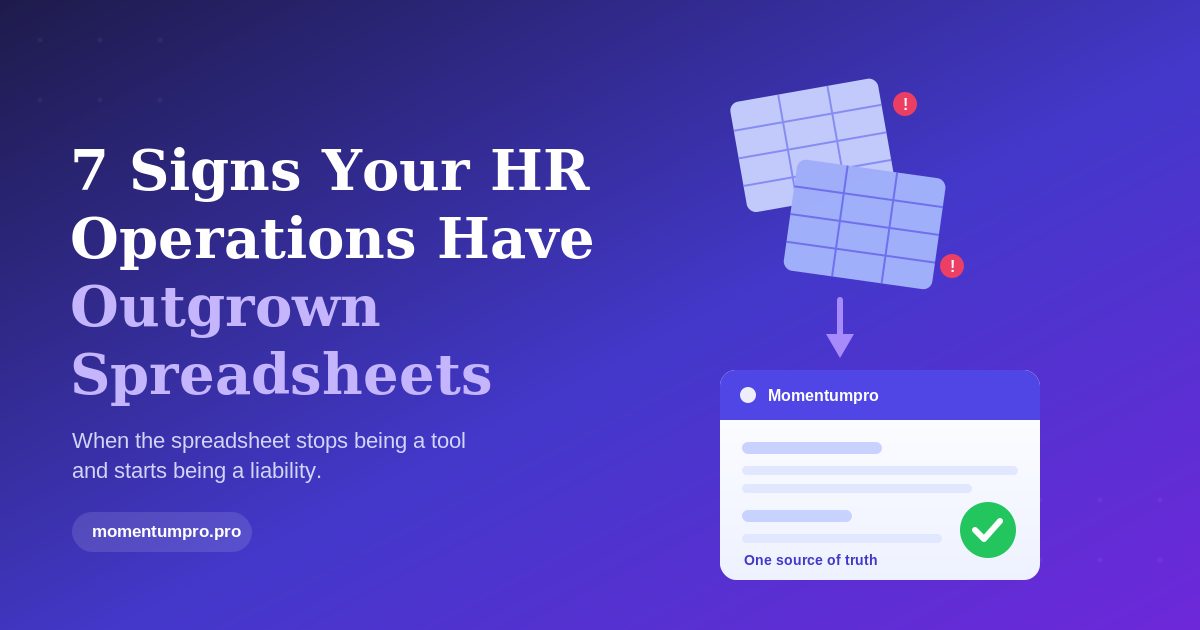
There's a moment in every growing company when the spreadsheet stops being a tool and starts being a liability. Nobody schedules it. No alarm goes off. One day you're just sitting in a meeting, someone asks a simple question — "how many people are on probation right now?" — and three different people open three different files and give three different answers.
If that scene feels familiar, you're not behind. You're growing. Spreadsheets are where almost every HR function starts, and for good reason: they're free, flexible, and everyone already knows how to use them. The problem is that the very things that make them great at ten employees quietly turn against you at fifty, and by a hundred they're costing you real money in ways that rarely show up on a single line item.
Below are the seven signs we see most often when a company's HR operation has quietly outgrown the spreadsheet. None of them is fatal on its own. But if you're nodding along to three or four, it's probably time to have the conversation.
1. The same data lives in five places — and none of them agree
This is the big one, and it's usually the first to appear. An employee's start date is in the payroll sheet, the onboarding tracker, the org chart, and someone's email signature template. Their phone number is in a different file again. When something changes — a promotion, a new manager, an address update — somebody has to remember every place it's recorded and update each one by hand.
They won't. Not because they're careless, but because no human reliably keeps five copies of the truth in sync. So the copies drift. And once your data has drifted, every report built on top of it inherits the error. You stop trusting your own numbers, which is a quietly corrosive thing for a leadership team to live with.
2. Approvals happen over email, and they vanish
Leave requests, expense claims, contract changes, salary adjustments — these are the moments where HR actually touches the business. In a spreadsheet world, they tend to happen in a thread: an employee emails their manager, the manager forwards it to HR, HR replies "approved," and someone, eventually, types it into a sheet.
The problem isn't that this is slow, though it is. The problem is that there's no record. Six months later, when an employee disputes how much leave they had, or an auditor asks who approved a particular payment, you're scrolling through inboxes trying to reconstruct a decision from memory. A proper system makes the approval chain part of the record automatically — who asked, who approved, when, and on what basis.
## 3. Onboarding and offboarding rely on someone's memory
Ask yourself: when a new hire starts on Monday, what guarantees they get a laptop, a system login, a payroll record, the right policies to sign, and an introduction to their team? In a lot of companies, the honest answer is "Sarah remembers to do it, because Sarah always does it."
That works right up until Sarah is on holiday, or leaves, or simply has a busy week. Offboarding is even riskier, because the cost of forgetting is a security problem: an ex-employee whose access was never revoked, or final pay that was miscalculated. When these processes live in someone's head instead of in a defined workflow, you're carrying a risk that scales with every new person you hire.
4. You can't answer simple questions quickly
Here's a quick test. How long would it take you, right now, to find out: how many employees you have by department, how much leave the company has accrued as a liability, which contracts or certifications expire in the next ninety days, or what your headcount looked like exactly one year ago today?
In a mature system, every one of those is a few clicks. In a spreadsheet world, each one is a small project — open the file, hope it's current, build a pivot table, double-check it against another file, and present the number with a quiet caveat that it might be slightly off. The cost here isn't just time. It's that leadership stops asking the questions, because getting answers is too painful — and a business that stops asking questions about its people is flying with the instruments covered.
5. Compliance has become a fire drill
Every country has rules about how you handle employee data, how long you keep records, how you calculate entitlements, and how you document decisions. Spreadsheets give you no help with any of it. There's no audit trail, no access control beyond "who has the file," no automatic retention, and no enforcement of the rules you're supposed to follow.
So compliance becomes reactive. You scramble before an audit, you patch things after an incident, and you cross your fingers that the one person who understood the leave calculation hasn't left. For a small team this is survivable. As you grow, and especially as you operate across multiple locations or jurisdictions, it becomes a genuine exposure — the kind that turns into a fine or a lawsuit rather than just an awkward afternoon.
6. Sensitive data is one shared link away from a leak
Salaries, bank details, ID numbers, medical notes, performance reviews — HR sits on the most sensitive data in the company. And in a spreadsheet, that data is protected by exactly two things: a file permission setting that someone configured once, and trust.
It only takes one "share with anyone who has the link," one file emailed to the wrong address, or one laptop left on a train. You can't easily see who has opened a spreadsheet, you can't revoke access cleanly, and you usually can't even tell after the fact whether something walked out the door. Proper systems give you role-based access — people see only what their job requires — plus a log of who looked at what. With a spreadsheet, you're trusting that nobody ever makes a single mistake, forever.
7. Your tools don't talk to each other
By the time a company has outgrown spreadsheets, it usually hasn't just got one. It's got a sheet for leave, a different tool for payroll, a separate system for recruitment, maybe a project tool that tracks who's working on what. Each one is an island. Moving information between them means exporting, reformatting, and re-importing — manual work that's both tedious and a fresh chance to introduce errors.
This is the hidden tax of a patchwork. Every island needs its own maintenance, its own logins, its own little reconciliation ritual. The real value of an integrated platform isn't any single feature; it's that the employee record, the leave balance, the payroll input, and the org chart are all the same underlying data, so nothing ever has to be copied between them.
So what does "outgrowing it" actually cost?
It's worth being concrete, because the cost of spreadsheets is real but invisible — it never arrives as an invoice. It shows up as the hours your HR team spends reconciling files instead of supporting people. As the decisions made on numbers that turned out to be wrong. As the compliance risk you're quietly carrying. As the good employee who had a bad onboarding experience because something fell through the cracks. And as the simple drag of a leadership team that doesn't fully trust its own data.
None of those line up neatly on a budget, which is exactly why companies tolerate them for far too long. The spreadsheet looks free. The chaos around it isn't.
How to know it's time — and what to do next
You don't need to hit all seven signs to act. A useful rule of thumb: if you're past roughly fifty employees, operating in more than one location, or simply spending more time maintaining your HR files than using them, you've crossed the line where a dedicated system pays for itself.
The good news is that moving off spreadsheets no longer means a six-month enterprise software project. Modern HR platforms are built to consolidate exactly the patchwork described above — employee records, leave, requests and approvals, documents, onboarding, and reporting — into one place where the data is entered once and trusted everywhere. The goal isn't to add another tool to the pile. It's to retire the pile.
Momentumpro was built for exactly this transition: the moment a growing company realises its spreadsheets have quietly become its biggest operational risk. If you recognised your own team in two or three of the signs above, that's not a crisis — it's a sign you've grown enough to deserve better tooling. The best time to make the move is before the next "how many people are on probation right now?" moment, not after.
---
Want to see what your HR operations look like when everything lives in one place? Explore Momentumpro or start a free trial today.